Embrace the Challenge

American Bantams are small cars which can be simpler projects than many of the other cars from the same era; they have very limited trim, they share a multitude of parts with other vehicles, they have far fewer parts then other cars, and most of those parts are a very manageable size.  Even better for the restorer, Bantam was a company which was known for going to the local hardware store to get bits to keep the line running.  Despite these positive attributes, don’t let the Bantam’s smart looks make you believe it won’t be challenging.  In fact, there are some parts which you will encounter along the way which are sure to provide a challenge to any restorer.  How do you overcome these challenges?  Patience.

While I could go on about what parts may be challenging, I will tell you the story about my efforts over the last year to reproduce cross-members for Bantam Commercial vehicles and four passenger convertibles.  All of the other models used some variation of C-channel as the rear cross-member, a simple solution.  The cross-member I needed was 1 5/16″ steel tube, bent in four places, and flattened at the ends.  On trucks, it served as part of the spare tire holder and on the passenger cars, it served as a rear cross-member that didn’t interfere with the rear seats.
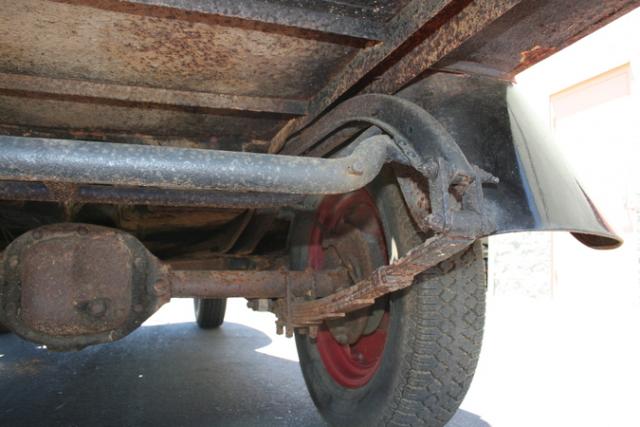
Bantam pickup underside

A Bantam Commercial crossmember in its natural habitat, a 1939 pickup truck.

With light kinking in each of the bends, I figured this is something which should be easily made.  I considered a Harbor Freight pipe bender, but decided against it due to the small radius of the bends.  I contacted people who built race car roll cages, they didn’t want to touch it.  Thinking of universal engine swap cross-members, I even contacted a number of aftermarket companies, who also wanted to stay far away from the project.  One race car chassis company offered to do it, but I never heard back from them after sending over a few photos of the part.

I realized I had to be missing something, it’s just bent pipe, there must be some way to have this made.  Being located in New York, I contacted a number of tube bending facilities.  The best I could find was a company which was willing to make 1,000 of the cross-members.  That would mean I would have enough units to replace the cross-members in 1/6 of the total Bantam production run.

After nearly giving up and preparing myself to accept a fresh piece of c-channel, I decided to make a few calls.  I went to google and typed in many variations of pipe bending or tube bending.  A company in Olean, New York said they may be able to do it but suggested another outfit who may be more inclined to take on the project.  It took me a while to get the sample to this other company to see what they could do.

Two weeks after getting my sample to the company, they had manufactured the component parts of two sets of prototype cross-members for me.

Bantam Crossmember Truck Riviera 1

My sample Bantam Crossmember which had seen better days and a couple of components to build two new sets.

To see how they fit, I unpacked them and brought them over to the shop project.  I’ll let you tell me how you think they fit.

I’m personally very happy with these parts.  My top goals were to have pieces made which looked identical to the original units while being substantially stronger and while remaining affordable.  These were a little more costly than I would have liked, but the manufacturer nailed my other two goals so well that the higher price isn’t as painful.  The only part which is visibly not original is the lack of a drain hole in the large tube.  This is something another person can add to their cross-member if they really want to have it.

I will need to fit them to the chassis and determine a few final details by installing these into the chassis of the shop project.  I’ll be posting detailed instructions of how they are installed once they are finalized.

The point of this article has nothing to do with the excellent quality of these reproduction cross-members, even though they are substantially beefier than the originals.  The point here is that there are very few things in a project that cannot be done if you are patient, make a reasonable assessment of your skills, and have the resources to make it happen.  Here is an overly simplified flow chart indicating a helpful process for reaching each of your goals:
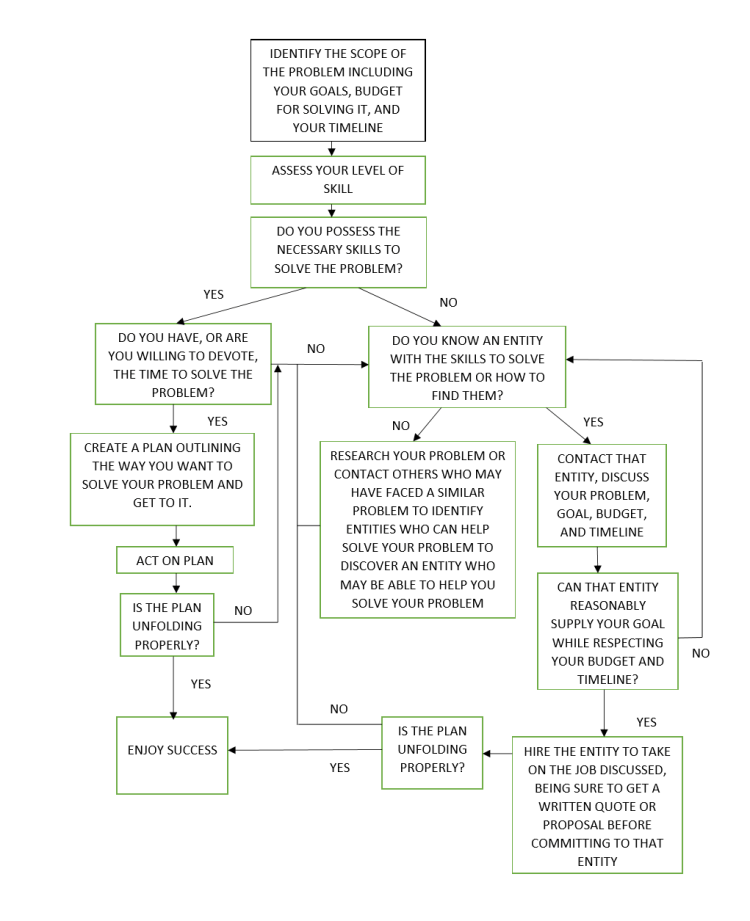
problem flow chart

Here is an illustration of how I perceive my path through this flow chart in pursuing a rear cross-member:

problem flow chart 1

As you can see, I got stuck in the research loop for a while, but in the end it paid off.  Researching or contacting other may even lead you to a finish product ready to solve your goals or a person willing to take on your project and do the necessary leg work.  Also, as always, one of the best things you can do is join both of the clubs.  More than likely, someone has been in the same boat as you.  If that person has never found a solution to their problem, perhaps together you can.  Or, perhaps they have found just the solution you have been waiting for.  For instance, if you contact me for a rear cross-member for a Bantam Speedster, a set of brake cables, or 100 new Bantam headlight lenses; I can help you.  If you need something else, I can certainly try to help you or point you in the right direction.

Enjoy your weekend!
 

Sportsman 2: Thank you Mr. Tremulis

A lot of you may have cringed previously when seeing my previous post, introducing the Sportsman: our shop project.  Here is part 1.  That reaction was mostly based upon the condition of the body which will form the basis of this project.  While I can wax on about the work that needs to take place in order to get these bits of scrap rolling again, a bit of a story is necessary.

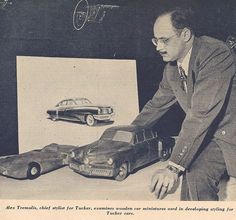
Without delving too deep into Bantam facts and lore, here is the most important part of Bantam history, maybe an exaggeration, besides that whole Jeep thing. Before the Bantam’s exit from civilian car production, Roy Evans, the president of the American Bantam Car company found himself in California. Driving a Bantam roadster around, he wished the car was a little more weatherproof. Seeking better side curtains, he asked around until he was recommended to the right man for the job. That man was Alex Tremulis.

alex tremulis

Alex Tremulis

Rather than trying to seal the roadster, Tremulis pitched the idea of an all-weather cabriolet.  Evans took to the idea, promising Tremulis a small allotment of money and a standard Bantam donor coupe. Afraid of Evans changing his mind, Tremulis immediately cut the roof off of the coupe so there was no going back. Sure enough, the president tried to change his mind, to only find the car beyond the point of return. With that, Tremulis set to work on what would become the Hollywood, a great Bantam. The visionary designer knew he was designing something special on a shoe string budget.

After taking a little off the top, reshaping the doors, and recycling sections of a REO Royal into a bustle; the coupe was transformed into a Hollywood. Capable hands made short work of the project and the car was a fully functioning convertible. The front sheet metal was standard Bantam issue, but from the windshield back every panel was modified. In the end, it was part tasteful custom and part prototype.


With Evans satisfied with the way the car was turning out, Tremulis wound up with the prototype Hillmaster engine which was new for 1940. The engine boasted 3 main bearings and overall better performance, than its two main bearing predecessor.  The engine built upon Harry Miller’s earlier improvements to the American Austin engine again squeezing out nearly 25 percent more power.

As part of the deal to design the car, Tremulis had to deliver the car from his shop in California to the Bantam factory in Butler, Pennsylvania where he had earned a position as the in house designer.  Making it to Butler in record time, some changes were made to the little cabriolet’s design before putting it into production.  While in Butler, Alex also turned his hand to designing the Bantam Riviera, a 4 place convertible sedan.  In total, over 150 of the convertible coupes were built. Out of the passenger cars built for 1940, a large number of them were the redesigned Tremulis models.

bantam super 4 poster

The new Super-4 models, both penned by Alex Tremulis.

You’ve seen some of my “surviving” bits of one of these Tremulis styled Bantams.  The Sportsman project will draw upon Alex Tremulis’ concept, the lines of his elegant drawings and the spirit of the car he hand crafted.  It will also take the model name of the Supercharged Cord 812 which some attribute to Tremulis.  However, there will be some departures from the original Bantam Hollywood body along the way; including constructing and skinning the body in wood similar to the post-war Ford Sportsman.

More to come!


American Austin Radiator Badges

Right now, there are two American Austin radiator surround Badges for sale on ebay.  They both have their original retaining clip on the back side (whether they will still work is unknown), but the enameling on the front is what sets the two apart.  These badges should have a deep, translucent red, enameling which fills the background and lettering even with the brass surface of the badge.

The first badge appears to have had all of the original enamel replaced with solid red paint.  You may be able to get this restored, but that can be an expensive process.

Click here: American Austin Badge 1

The second badge has had some polishing work done to the brass surface but it looks like it retains a lot of the original enamel although it appears there are some chips.  Is it perfect?  Not quite, but it is one of the nicer badges which has found its way onto ebay in a while.

Click here: American Austin Badge 2


Laziness: The key to ingenuity?

Years ago I worked in a marina and was allowed to keep a project boat in the murky shallow water section.  The boat was a pleasure boat which served as a barge by a bridge repair company.  The interior was singed by slag and irreparably tinged with the grime of many hard days of work.  However, the boat ran strong and was priced nicely at free.

It was an extraordinarily hot summer, so I worked mainly in the early morning and from dusk onward.  With the spare middle hours of the day, I would often work on honing my battered craft into something a little better.  Since my boat was near the raised walk way which brought boaters from the land to the slips in the middle of the river, a lot of other boaters would pass while I toiled.  A lot of them would offer a few kind motivating words, some offered joking criticism, and some others offered advice.

Honestly, I don’t remember many of the conversations specifically.  However, I can remember one as though it was had this morning.  It was with sail boater who walked by several times each day, but never usually said anything.  On one particularly blistering day.  He was a middle aged man with a long forgotten accent from a European country.

“You work too hard,” he told me.

I just smiled and laughed, thinking he was ribbing me.

“No, seriously,” he said.  “You work too hard.”

Most people cajoled me into working harder each day.

“How can I expect to have a nice boat if I don’t work for it?” I asked.

The conversation went on like this for a few minutes.  He hinted that merely breaking my back in the sun wouldn’t translate into having a perfect boat at the end of the summer.  I was a teenager and was under the assumption that hard work unequivocally translated into success.  Finally, he sought to break down his arguments into a single phrase:  “Laziness is the key to ingenuity.”

Apparently, he was an engineer of sorts and he gave me some examples of successful inventions rooted in laziness.  As a teen, you often take words at their face value and don’t necessarily contemplate their undertone or context.  Earmarking that phrase in my head, I would attempt to find use for it at many points during my life.  As I’ve tried to apply it, I’ve sought to hone its meaning further and further from a blunt object into a useful tool.

To me, the man’s advice doesn’t mean that shirking hard work will transform you into a Nobel Laureate inventor.  To me, it means that a you need to be considerate and thoughtful in approaching adversity; you can’t expect blunt force to work every time.  You need to understand your objective, your priorities in reaching that objective, the resources you can devote to it, your expectations in solving the problem, and you need to be willing to devote time to finding the best solution for you.  Sometimes, the result of your consideration may reveal that you cannot fully solve the problem and you need to seek the help of others.

A project that inspires dreams too often can become an albatross to its patron.  It’s usually a single problem that causes the momentum of progress grind to a halt.  Once that momentum is lost, dust begins to collect and inspiration dissipates.  Eventually, many forlorn projects change hands to a new, rosy-eyed, owner.  Perhaps more frustrating, many people who long for the accomplishment of a finished project, will never take it on believing they will never be able to carry it to completion.

As for me and that boat, I never finished it.  I didn’t return to the river to work the next summer and never had the time to devote to finishing it; it just wasn’t a priority.  I think I probably still have some pieces of it here someplace, although most of it went on to keep other boaters dreams afloat.

The moral of this entry is that you need to figure out how “laziness” will reward you.  Perhaps you have a project, or are searching this site for one.  Each project offers its own unique challenges and rewards.  If you haven’t done so already, you should consider joining the Austin Bantam Society and the American Austin Bantam Club.  There are hundreds of other club members; many who would love to help you with their skills and many who you could perhaps help with your own skill set.


The Shop Project: Sportsman I

Perhaps I’ve introduced this project before, but I can’t find the post.  So, in the case I’m repeating myself, I’m going to try to spice this story up for you and present it from a new direction.

This story begins in 2013, when I had tried, to no avail, to buy several different Bantam Hollywoods and Convertible Coupes.  At that point, this website didn’t exist and a person interested in a Bantam was not faced with the paradox of choice you have today.  What did exist was the ability to pursue leads in a scattershot approach with the hopes that something great would turn up exactly when you were looking.

One night, using my scattershot approach, I found a craigslist ad in Tehachapi which piqued my interest.  Now, if you didn’t already know, Tehachapi is in California; a place I have never been.  For us on the east coast, California is known as a haven where all of the antique cars are rust free.

The ad described a hoard of fantastic proportions, at least with relation to the market of the time.  There were a few photos of the whole collection and just one illustrating the gem of the collection, remnants of a 1940 Bantam.  The car had been picked clean over the years and had undoubtedly given life to many other Bantams.  Yet, there was something about it that made me think it needed to make the journey to New York.  Thoughts of turning it into the car of my dreams ran through my head, without knowing exactly what those dreams were.  Seeing the body, I knew it could be a blank slate of sorts.  One where I could exercise some creativity without destroying something likely to be restored.  I could try to break the mold a bit with this one.

By the time the plans for the body began to materialize in my mind, the lot was spoken for, but thankfully the buyer and I were able to get in touch with each other.

Here is a photo from the ad:

thumbnail_2013-10-27 11.13.40

Here is the body emptied out:

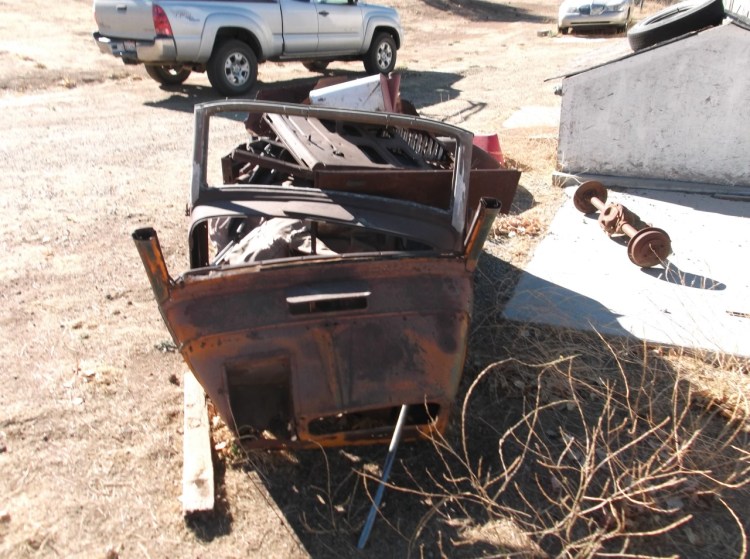
Remants of a 1940 Bantam

An original California car.


Here is a front view:

front view

Front view of the 1940 Bantam

As you can see, it is a bit rough and you may thinking it is more of the stuff of nightmares than dreams.  However, this body isn’t all that bad for what I am planning.  Stick around for more updates and learn about its trip across the country to its new home.

As a disclaimer, my mechanical, sheet metal, and woodworking skills are fairly weak.  This will be a learning experience and will hopefully give others the courage to adopt a project in need of a lot of love.

The curious case of number 65530

On November 1, 1939, a Master Roadster rolled off the assembly line.  It was a left hand drive car with engine 65707, which would be a Hill Master with three main bearings.  Nothing seems extraordinarily out of place about this car and happily, it has survived.

Here it is in all of its glory:

Data Tag story 1

You can find it on ebay here: 1939 Bantam Roadster

The problem with attempting to learn things from a car with an older restoration is that you never know exactly how authentic something is, especially when dealing with a company known for going to the local hardware store to buy bits to keep the assembly line running.  This car is advertised as a 1939.  It has 1939 bumperettes, fender skirt trim, exhaust pipe, and an early hood ornament.  Yet, it also has 1940 hood side trim, a 50 lb oil gauge, a single cam Ross steering box, a frame with hydraulic shock mounts, a three main engine, a proper zenith carb (mounted backwards),  an underdash parking brake assembly, trimmed/louvered inner fender aprons, and a 1940 style shift lever.


As you can see, not only does it have a three main bearing engine, which a lot of restorers have upgraded their cars to, it has its “born with” three main.  So as most signs point to this car being a Series 65 you must be wondering whatever could be the point of this rant.

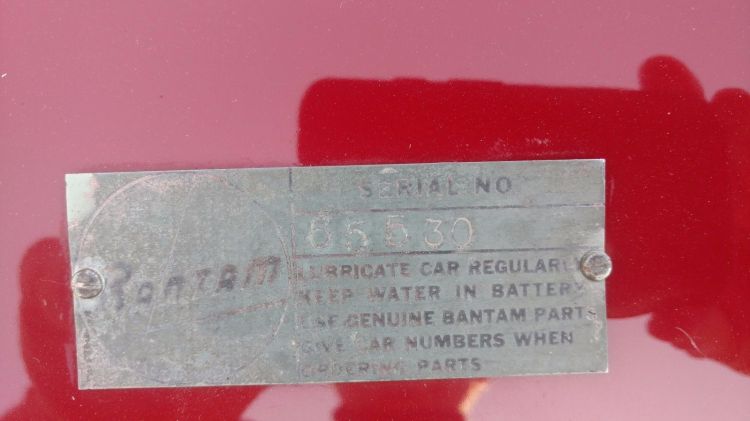
So, here it is, the wrench that has gotten stuck in my gears:

Data Tag story 2

Nothing curious about this tag, it looks very original.  It has visible etching, it has the correct font, it is even held on with the proper screws.  However, if you look carefully, it’s completely out of place.  According to the Authenticity Manual which is published by the AABC, beginning with car 64570 Bantams received a much larger tag.  Something like this:

dsc_5084

Aside from the fact that this car has what you may think is the “wrong tag”, if you look at the two tags illustrated above, you’ll notice the stamped font is the same.  Although similar to the number stamps used on the engine blocks, warranty tags were stamped with a slightly smaller variation thereof, and the warranty tags supposedly only began being stamped with this font at the introduction of the larger style tag.

I may have stated this here before, but the Roadster was intended to be obsoleted by Bantam in 1940.  Out of about the 1000 plus cars making up the 65 series run, only around 40 Roadsters were built.  Perhaps these bodies were already on hand and were just waiting for a chassis to slip underneath.  Perhaps all of these left over series 63 roadster bodies had this style tag attached.  However, there are other roadsters with earlier serial numbers which do have the larger style tag.  I would be curious to know if this body features the shorter cowl which many other 1940’s have been found to have, perhaps that may lend some insight as to why this car has retained a much older tag than the car actually is.

Without knowing the exact life this car has lived since November 1939, it would be impossible to know if this tag is 100% correct for the car.  For all we know, someone restoring the car in the 1960’s may have had access to an NOS factory tag and the factory stamps; no matter how unlikely that may seem.  I would venture to guess that this is the original plate for the car, proving itself to be an exception to a long accepted rule.


Ron Hackenberger Update

Perhaps you’ve heard about the Hackenberger auction in the past few weeks.  With over 700 lots, this auction has a lot of very interesting items and it has been widely publicized.  If you are one of the subscribers to our “Lead Sheets” you have probably seen three Austins and Bantams coming up for auction today.  After all was said and done, the three cars found new homes.  Here is a snapshot of the auction results.

Screenshot (316)

After weeks of online bidding, the convertible coupe lingered around $850, the roadster remained strong at $350, and the coupe was around $750.  The morning of the auction, the Convertible coupe ascended to ~$5,700, the roadster to ~$500, and the coupe to ~$1,200.  Once the bidding began on the roadster, a small power surge interrupted the internet bidding; but that didn’t stop it from being a runaway hit with internet bidders.  Note, the prices published do not include any of the premiums which were tacked on for the lucky winners. (Somewhere between 8% and 17%, in different areas of the terms).

At the prices realized, it may be safe to assume that the convertible coupe and roadster will be on their way to enjoyment in their original form.  However, the softer value the crowd placed on the coupe makes one wonder what its fate may await it.

If anyone who purchased one of these cars happens to read this, it would be great to know more about your new car and welcome you into the fold.  If you are a person who was bidding on these cars but didn’t end up going home with one, send us a line as there are plenty of cars looking for a warm space in your garage.

Still Bantaming!

First off, happy Summer!  It’s been a very busy few weeks and I have been neglecting this site a little bit.  A lot of my focus has been stolen by work and in getting a few reproduction projects off the ground.  There are enough projects in the works that I have a binder which is starting to fill up with everything to keep track of these efforts.

If you received the ABS’ most recent Rooster Tails, you may have seen an article about our effort to reproduce headlight lenses, if you are interested, I am taking preorders until mid-September.  Hopefully, there will be a table at the upcoming meet in Reading, PA showcasing our latest reproduction parts as well as lots of other goodies, used and new alike.

The lead sheet has really blossomed in the past month.  To be honest, there are so many vehicles for sale at this point in time that its sometimes hard to keep track of them all.  A few of the cars advertised on this site have sold and I need to update the classifieds with some new cars which are available.  Lead sheet V. 1 LS. 5 should be available this weekend.  If you aren’t a member of either club, just think, you could have had a copy of every lead sheet released this year emailed to you for free for the cost of membership in one of those clubs.

In other news, we have now secured the URL http://www.EverythingBantam.com.  You can reach this page by typing that in.  At some point, this whole site will be migrated to that URL.  You can also find Everything Bantam on Facebook, Twitter, and Instagram (although I admittedly don’t know how to use that one yet).  Soon, the content of the three pages will be coordinated with each one having some unique nuggets of Bantam gold.

I am working on updating the parts section of the website to reflect actual used parts available on ebay, new parts available through us and other vendors, and nos parts.

Most importantly, I am getting back to work on the Shop Project, the Bantam Sportsman.

Thanks for checking in!


Parts Interchange: Austin Handles

At this point, no one is reproducing American Austin interior handles.  Like many door handles and window cranks utilized on 1930’s vehicles, these were made of fairly poor materials.  Fairly often, these handles are broken where they interface with the latches or regulators and they are usually fairly pitted.  If you are looking for handles for your cars, there seem to be at least two other makes which utilized the same handles as the American Austins.

First, a few months ago, Lynn introduced us to the 1931 DeVaux which featured the same handles as the Austin.  Interestingly, the DeVaux featured some styling treatments from Alexis de Sakhnoffsky, the same man responsible for much of the American Austin and Bantam looks.  These may not be a good source for parts as only 4,808 vehicles were produced and the survival rate does not seem to be very good.

1931 DeVaux

1931 DeVaux Model 675

If you blow up the photo below, you can see the handles which are the subject of this blog post.

1931 DeVaux interior

Note the Austin handle and crank on the passenger side door.

To learn more about De Vaux, click here.  To learn more about the car in the above photos click here.

Another vehicle that featured these same handles is the 1930 Peerless.  The very same car that was considered to rival Packards and Pierce Arrows utilized the same window cranks as the diminutive American Austins.

1930 Peerless

1930 Peerless Model A Standard Eight

Here is a photo of the handles in the opulent and luxurious interior of the Peerless.

1930 Peerless Interior

Those window cranks and handles look familiar, don’t you think?


1930 Peerless hayes body tag

The Peerless Body Tag.

To learn more about Peerless automobiles click here.  To learn more about the Peerless above, click here for the craiglist ad or call Ed at (602) 421-5663  if the ad has expired.

Drew best described the Peerless as the missing link identifying that these handles may have been a common part for the Hayes Body Corporation who built the bodies for all three cars.  So, keep your eyes open at the swap meets.  These handles are out there, albeit probably in limited quantities.